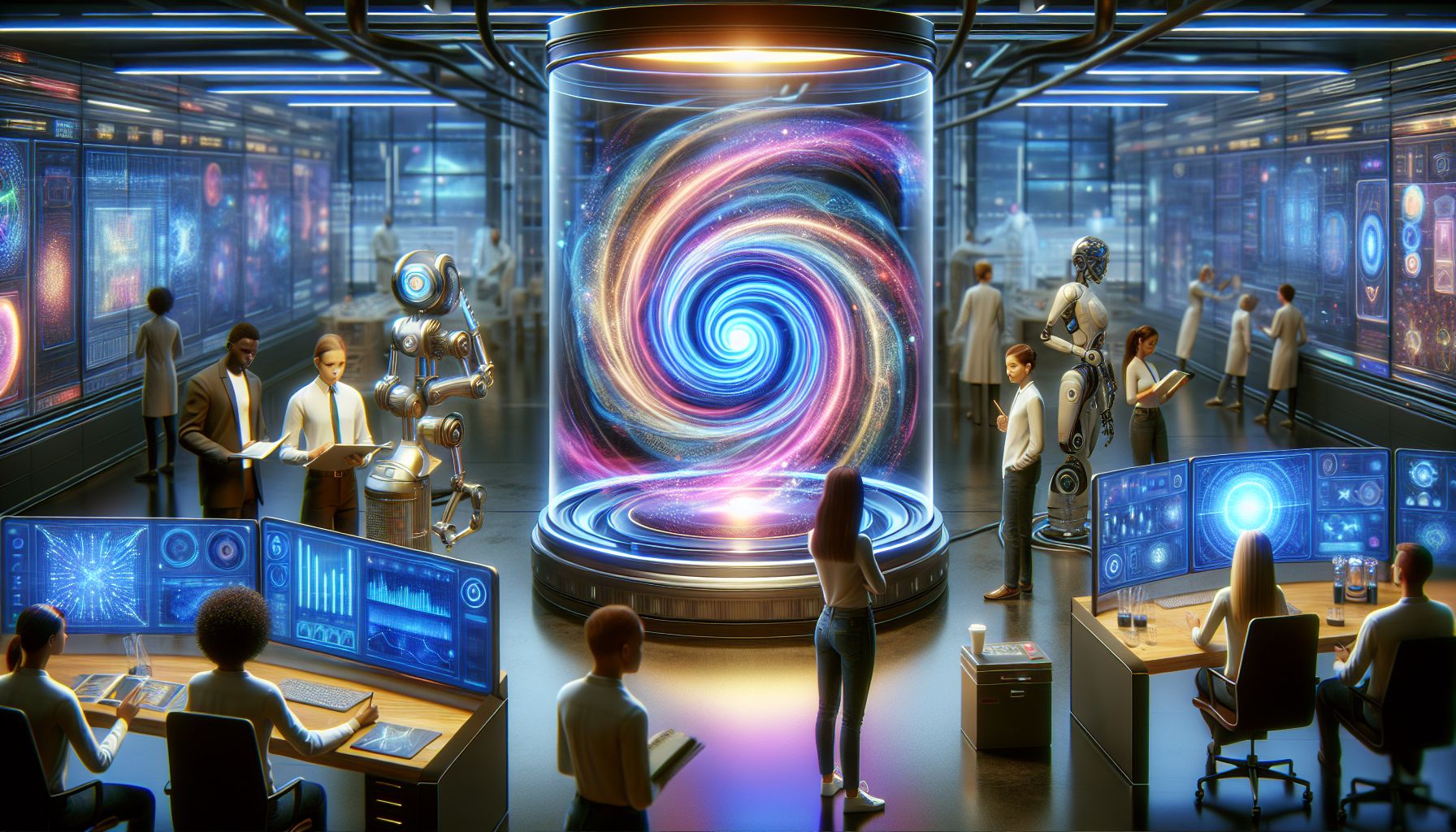
Hey, techies and future enthusiasts! It’s a thrilling time to be alive, especially if you’ve had even a smidge of curiosity about the creative potential of Artificial Intelligence. After guzzling up articles and discussions, I decided to unload some of my excitement into this blog post. Today, let’s dive headfirst into the world of AI in the creative arts—a domain that’s changing fast and really messing with how we think about creativity.
AI: The Unexpected Artist
Alright, so when we think of creativity, AI might not be the first thing that pops into our minds. Creativity is like the magical unicorn of the human experience—complex, unpredictable, and utterly mesmerizing. But, here we are in the 2020s, having conversations about AI that crafts poetry, paints evocative images, and even composes symphonies. Who would’ve thought?
The likes of OpenAI’s GPT and DALL-E are like those mysterious, slightly intimidating art students who surprise you with their impressive portfolios. These systems aren’t just tools; they’re collaborators, albeit ones that never ask if you’ve got any spare change for coffee. GPT models, for instance, have been trained on massive datasets of human language, learning to craft narratives with impressive coherence and style. And then there’s DALL-E, capable of visual creativity, taking text prompts and turning them into pixel-perfect artwork. It’s a wild, wild world out there.
Unleashing Creativity Without Boundaries
One thing that really gets me excited is how AI is democratizing creativity. Imagine having an artist’s studio, a recording studio, and a writer’s desk all rolled into one accessible platform. AI-powered tools are enabling people who might have stared at blank canvases or journal pages, intimidated by their own perceived lack of creativity, to finally unleash their inner artists. It’s not just about professionals using technology to enhance their art; it’s about including everyone in the creative process.
Take music, for example. Software like Google’s Magenta is helping musicians put together new arrangements and even compose new pieces. Picture telling an AI to generate a few bars of melody based on a mood or theme and then rolling with it. Kind of like having an overly enthusiastic bandmate who’s never out of ideas.
The Collaboration Between Human and Machine
Here comes the philosophical bit! What’s fascinating (and a bit mind-boggling) is that AI doesn’t replace human ingenuity; it enhances it. We provide the contextual understanding, emotional depth, and uniquely human touch. AI brings the grunt work, speed, and the ability to process information faster than you can say “Turing Test.” Together, it’s like forming a rock band with a supercomputer on lead guitar.
The Internet is peppered with examples of artists working hand-in-hand (or code-in-hand?) with AI, from futuristic fashion designers using AI-generated patterns to cinema creatives employing AI to storyboard complex scripts. We’re no longer dealing in hypotheticals. Creators are actively embracing AI as a partner that complements, even stretches, their natural abilities.
One Foot in the Future
Let’s peek into the crystal ball for a moment. What’s the endgame here? Are we going to find ourselves in a world where every novel is co-written with AI, or where films are entirely conceived by algorithms who’ll win Oscars? I doubt it, but I wouldn’t rule out some wild collaborations making waves.
Speculation alert! Companies and startups are chugging along toward an era where AI could help solve creative roadblocks or generate rapid-fire ideas while conferring a distinctive style to each project. The way I see it, AI could very well become a standard tool in the creative toolkit, as essential as paintbrushes or musical instruments.
Besides that, we’re also thinking about personalized art experiences. Imagine VR galleries tailored just for you, with AI recognizing your preferences to put together custom art shows. Artists, brands, filmmakers could start moving toward hyper-personalized experiences at unseen scales. It’s not sci-fi, it’s next-gen multimedia reality around the corner.
The Challenges on the Horizon
It wouldn’t be fair to only focus on the candy-colored rainbows of AI creativity without acknowledging a few storm clouds, though. There’s a bag of ethical questions bouncing around like popcorn in a microwave. Who owns AI-generated art? Is it the coder, the data scientist, or the AI itself given the honorary rights?
Moreover, not to sound like a doomsday preacher, but we do need to stay vigilant about biases in AI. If the data training these systems is even somewhat skewed, the outcomes will reflect that, potentially propagating stereotypes rather than erasing them. It’s a tightrope walk, requiring responsible development practices and open discourse.
Also, there’s the question of AI’s impact on jobs. As AI systems prove their worth in creative processes, concerns about job displacement echo through many industries. However, optimists (like me!) believe that rather than replacing creatives, AI will reposition them, freeing up pursuit of original, out-of-the-box ideas while letting AI handle more mundane tasks.
Conclusion
As we probe the intersection where technology meets the arts, this blended reality of AI-driven creativity is invigorating. These advancements ignite both potential and caution, a bountiful mix of excitement for what’s next and diligence to ensure ethical evolution. It’s a field as boundless as our imaginations.
To witnesses of this unfolding story: we’re not observers; we’re participants. Whether you’re a hardcore programmer or a sweet-toothed digital artist, grab some popcorn, scratch that, a quill or brush, and jump in. The era of AI-artistic fusion is just beginning, and I for one, can’t wait to see where this wild ride takes us!
Stay curious and dare to dream, folks. Until next time, keep pushing boundaries and keep challenging the silicon horizon.